Swan's theorem

A part of mathematics I really an starting to enjoy more is mathematics that explain or develop connections between geometry or topology, and algebra. The first two posts on this blog was focused on developing some geometrical insight to two lemmas from commutative algebra, namely Noether’s normalization lemma and Zariski’s lemma. There are many more such connections worth discussing and exploring, and today I want to focus on one of these “bridges” between geometry and algebra, namely Swan’s theorem. This theorem tells us how nice objects “over” another object in geometry relate to nice objects “over” another object in algebra. ...


June 24, 2020

The homotopy category

This is part 9 of a series leading up to and exploring model categories. For the other parts see the series overview. Last time we ended by giving a definition of a homotopy between maps on the collection of bifibrant objects in a model category. Today we are going to expand further upon this idea, and try to build the theory we are familiar with for topological spaces but in the general setting. The goal is to have a well defined workable notion of a homotopy category, and understand what it consists of. ...

June 14, 2020

Homotopy in model categories

This is part 8 of a series leading up to and exploring model categories. For the other parts see the series overview. Last time we finally defined the model category, gave some examples and tried (kind of) to give a motivation to why they are interesting and how they set the stage for homotopy theory. The first time I read the definition I was a bit confused about the lack of mention of homotopy, or at least some prototype of it that I could connect with. This structure on a category is supposed to embody where homotopy theory works, but failed to immediately convey that to me. But, that said, we will today go through the construction of homotopy, and prove that it is an equivalence relation on maps in nice cases. These cases we mentioned in the previous part, and will be maps between objects that are both fibrant and cofibrant, which I will refer to as bifibrant. ...

June 7, 2020

Model categories

This is part 7 of a series leading up to and exploring model categories. For the other parts see the series overview. Finally we have made it to the destination we set, namely, more abstraction. This post is focused on the definition and intuition on model categories, which abstracts the objects we have been studying for some weeks, namely fibrations and cofibrations. The main definition is that of a model structure on a category, which together with a nice category will form the definition of a model category. So, why do we want this? There are more than one reason. ...

June 6, 2020

Cofibrations

This is part 6 of a series leading up to and exploring model categories. For the other parts see the series overview. Through the series so far we have covered the basic uses of fibrations and related things, like the long exact sequence of homotopy groups, the Serre spectral sequence, fiber bundles and homotopy groups of spheres. But, we have not mentioned that fibrations has a dual construct, namely cofibrations. The road we are heading with this series, as mentioned before, is to define Model categories, and discover how to use them. Up until now, and including this post, I have been pretty comfortable with the objects of study, and I feel i know them quite well. After this post tho, I think I’m entering unknown territory for me, which is good! ...

June 2, 2020

Hanging pictures with homotopy

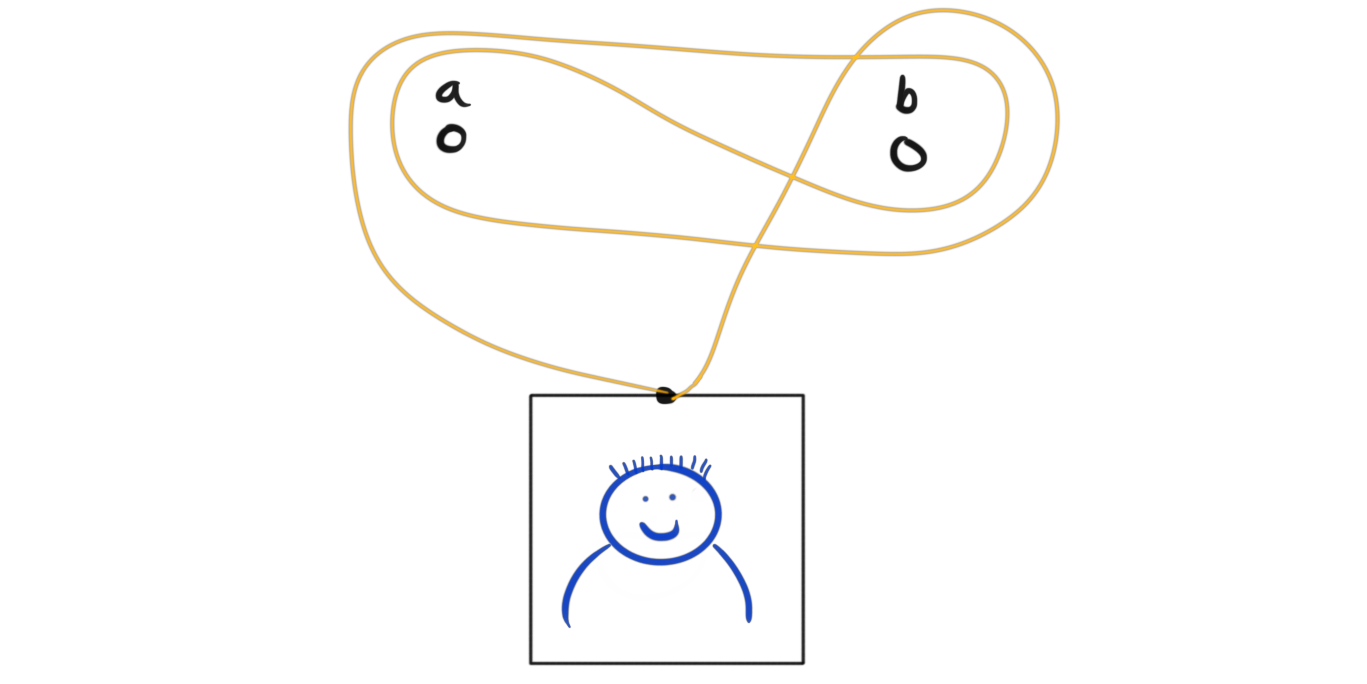
Some time ago I saw this problem of hanging a picture on the wall using a string and two nails in such a way that if you remove one of the nails from the wall, the picture falls down. This is a bad way to hang pictures you immediately say, and I would agree. I saw some solution to the problem, and didn’t think about it for many years, until this week when I figured out that we need homotopy, in particular the fundamental group, to do it! Finally a real world practical useful application of homotopy theory! Take that society. ...

May 29, 2020

A homotopy group of a sphere

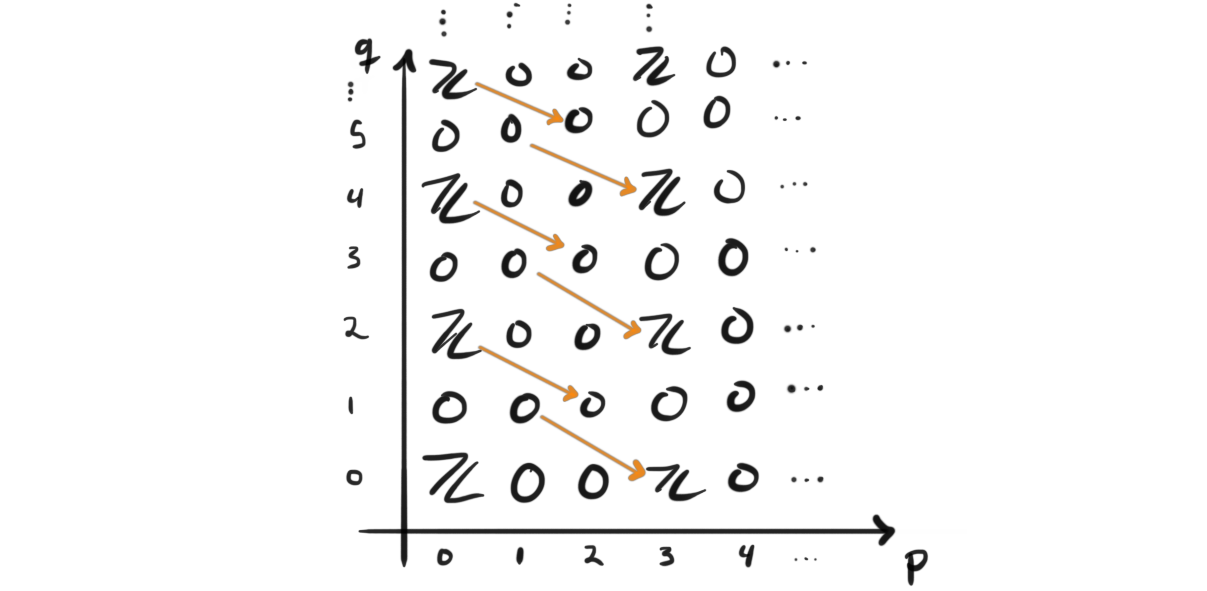
This is part 5 of a series leading up to and exploring model categories. For the other parts see the series overview. As promised in the previous part, we are going to calculate $\pi_4(S^3)$. I think we will have to use all of the machinery (plus some new) that we have been through during this series to do the calculation. What more could we possibly need you ask? Last time we developed the machinery to calculate the cohomology of the total space of a fibration, but we want to compute homotopy. Hence we need a method for translating cohmological information into homotopical information, which is what we are missing to be able to do the calculation. There may be other processes that I haven’t learned, but the process I know goes through two steps. First we must translate cohomology into homology. This is done through the so called cohomological universal coefficient theorem (cUCT). Then we need to translate from homology to homotopy. This is done through the Hurewicz theorem. I think of these two theorems together as sort of a Rosetta stone for algebraic topology. It makes us able (with some computation and restrictions of course) to move between the three fundamental theories of invariants we have in algebraic topology, which I find beautiful. There is one more thing we need, which is a starting point for our calculation. We need a good fibration to extract the information we want which we are able to translate into homotopy afterwards. Therefore we need a space in the fibration that does not complicate things when we translate into homotopy, i.e. we need a space in which we completely understand its homotopy groups. The “homotopy-easy” spaces I’m describing are called Eilenberg-MacLane spaces. In cohomology (and homology) theory we have the easy spaces being spheres because we completely understand their cohomological structure. They cam be thought of as the building blocks for (co)homology. The same type of space for homotopy is exactly theese Eilenberg-MacLane spaces, and they form the building blocks for homotopy groups in the same way as the spheres for (co)homology. Hence we can combine these spaces and spheres in a fibration and use that to compute cohomology and then relatively easily translate this to homotopy, which is exactly our plan for computing $\pi_4(S^3)$. ...

May 28, 2020

The Serre spectral sequence

This is part 4 of a series leading up to and exploring model categories. For the other parts see the series overview. My personal favorite part about fibrations is that they come equipped with a natural way to compute the cohomology of the total space from the cohomology of the base and the cohomology of the fibers. This process is encoded in a structure called a spectral sequence, and is a complicated object in its full generality. It consists of layers upon layers of intertwined cohomology groups, all sewn together by homomorphisms. But when I first learned their computing power, and learned how to use them, I fell in love with the structure. If you visit my homepage you will find several small write ups using spectral sequences to prove theorems and do computations of cohomology rings etc. Therefore, I want to create a nice introduction to how to use them, given a fibration. Technicalities of the structure of the spectral sequences will be omitted, but the definitions will of course be given. ...

May 27, 2020

Homotopy groups

This is part 3 of a series leading up to and exploring model categories. For the other parts see the series overview. For an introduction to the material, the definitions, motivation and some examples, please read part 1 and part 2 about fibrations and fiber bundles. This and the the following parts of this series will be about their usefulness, especially in computing homology and homotopy groups. This will be done through two different techniques, namely the long exact sequence of homotopy groups, and the spectral sequence associated to a fibration. In this this part, we look at the long exact sequence. This is a tool that will let us relate the homotopy groups of different kinds of spaces to each other, and ultimately, will help us compute the homotopy groups of fiberbundles from the homotopy groups of the base space, and the homotopy groups of the fibers. Forward, we always have pointed spaces, and the base spaces of our fibrations are simply connected. To be a bit more self contained, we remind ourselves what a long exact sequence is. ...

May 16, 2020

Fiber bundles

This is part 2 of a series leading up to and exploring model categories. For the other parts see the series overview. Yesterday we discussed the standard definition of a fibration by the homotopy lifting property, and today we are continuing that discussion, but in a more visual manner. This we will do by first looking at fiber bundles, and then generalizing them. Since fibrations are generalized fiber bundles, every fiber bundle is an example of a fibration, and they have been the most important examples for me, as they help me visualize and get intuition into the fibrations without having to really use the full generality of the definition. The main idea of a fiber bundle is that of a family of topological spaces parameterized by another topological space. This family will again form a topological space usually called the total space of the fiber bundle, while the space that parameterizes it is called the base space. Before we get rigorous and technical with definitions, we explore an example. ...

May 15, 2020