The stable homotopy category

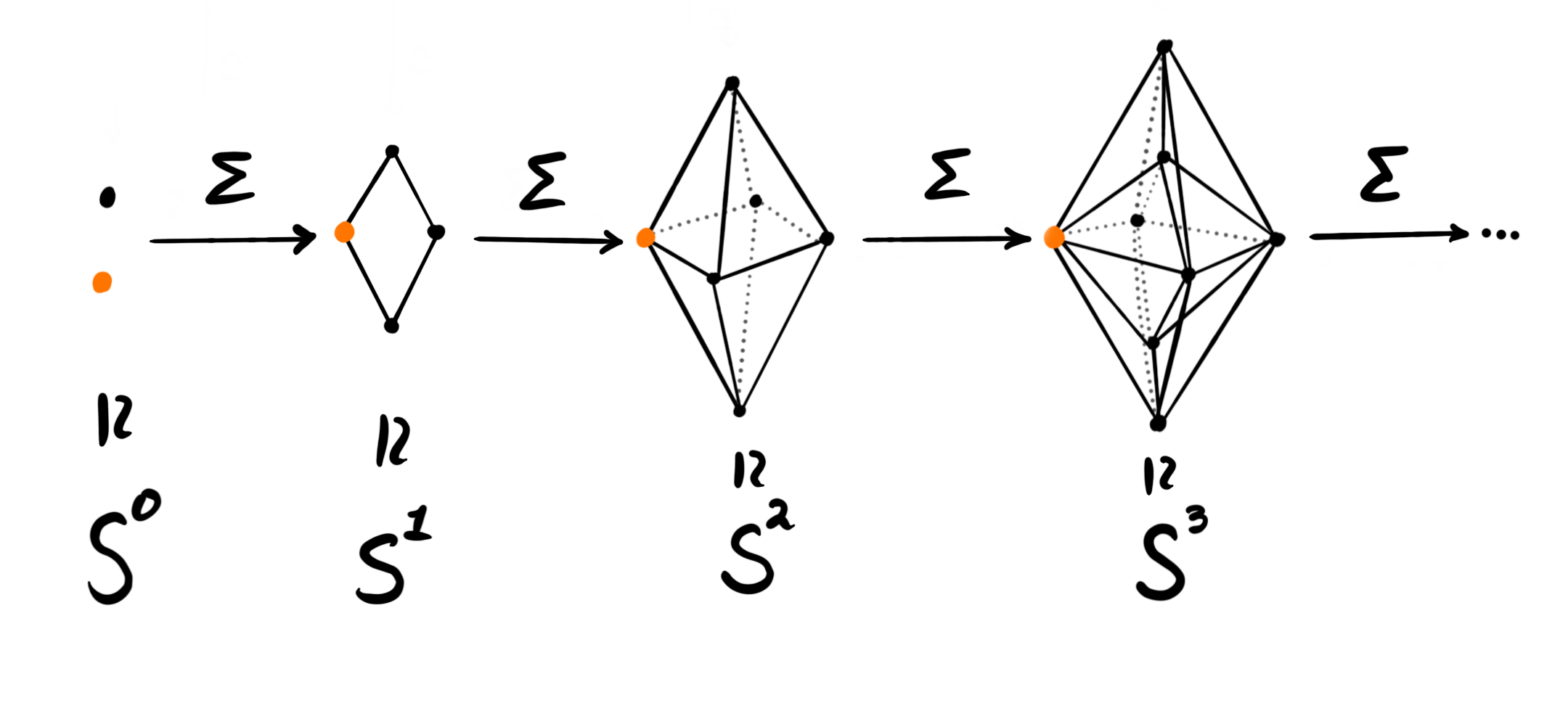
A little while ago we discussed the definition of a tensor triangulated category, and in that post we mentioned an example that we didn’t explicitly define, namely the stable homotopy category. The goal for todays post is to fix this. There are many ways of defining it, and some are actually better than others. As the name suggests, the stable homotopy category is a homotopy category, which we have discussed before in the fibration series. But the question is, what is it the homotopy category of? As we remarked in the post on tensor triangulated categories, it is the homotopy category of the category of spectra, and it is here that the different approaches lie. What exactly is the category of spectra, and which spectra are we even talking about? Is it the sequential spectra? or maybe the orthogonal spectra? or perhaps the symmetric ones? maybe $S$-modules or excisive functors? All these names of course means nothing to us yet, as we haven’t properly looked at any of them. We did however meet the $\Omega$-spectrum in an earlier post, but which of the above types does it belong to? ...

October 1, 2021

On formal DG-algebras

I have recently handed in and defended my master thesis in mathematics, so I though I would go through its abstract and try to explain what it’s all about. We look at formality of DG-algebras, Massey products, A_infinity-algebras and how we can use these to some interesting results.

July 19, 2021

The homotopy category

This is part 9 of a series leading up to and exploring model categories. For the other parts see the series overview. Last time we ended by giving a definition of a homotopy between maps on the collection of bifibrant objects in a model category. Today we are going to expand further upon this idea, and try to build the theory we are familiar with for topological spaces but in the general setting. The goal is to have a well defined workable notion of a homotopy category, and understand what it consists of. ...

June 14, 2020

Homotopy in model categories

This is part 8 of a series leading up to and exploring model categories. For the other parts see the series overview. Last time we finally defined the model category, gave some examples and tried (kind of) to give a motivation to why they are interesting and how they set the stage for homotopy theory. The first time I read the definition I was a bit confused about the lack of mention of homotopy, or at least some prototype of it that I could connect with. This structure on a category is supposed to embody where homotopy theory works, but failed to immediately convey that to me. But, that said, we will today go through the construction of homotopy, and prove that it is an equivalence relation on maps in nice cases. These cases we mentioned in the previous part, and will be maps between objects that are both fibrant and cofibrant, which I will refer to as bifibrant. ...

June 7, 2020

Model categories

This is part 7 of a series leading up to and exploring model categories. For the other parts see the series overview. Finally we have made it to the destination we set, namely, more abstraction. This post is focused on the definition and intuition on model categories, which abstracts the objects we have been studying for some weeks, namely fibrations and cofibrations. The main definition is that of a model structure on a category, which together with a nice category will form the definition of a model category. So, why do we want this? There are more than one reason. ...

June 6, 2020