The homotopy groups of the spheres. Part 1

Recently I gave a talk about the homotopy groups of spheres, and as usual, I try to collect my thoughts on this blog before (or after) presenting. The homotopy groups of spheres have featured several times on this blog, and we have made some effort into calculating them for some small dimensions. In the talk I wanted to showcase some methods used to calculate these groups, as well as doing some of the “calculations”. We have met several of the tools before, like the long exact sequence from a fibration and the Freudenthal suspension theorem, but we will also meet some new ones, like the $J$-homomorphism and the $h$-cobordism group. These two are methods for calculating the stable homotopy groups of spheres, or at least some of their subgroups. For the low dimensional cases, these subgroups will luckily be the entire groups. Due to the length of the post I have split it into two: one covering the unstable homotopy groups, mostly focusing on the Hopf fibration, and one covering the stable groups, mostly focusing on the image of the $J$-homomorphism. Before we start we recall the definition of the homotopy groups of spheres. ...
October 26, 2021

Hanging pictures with knots

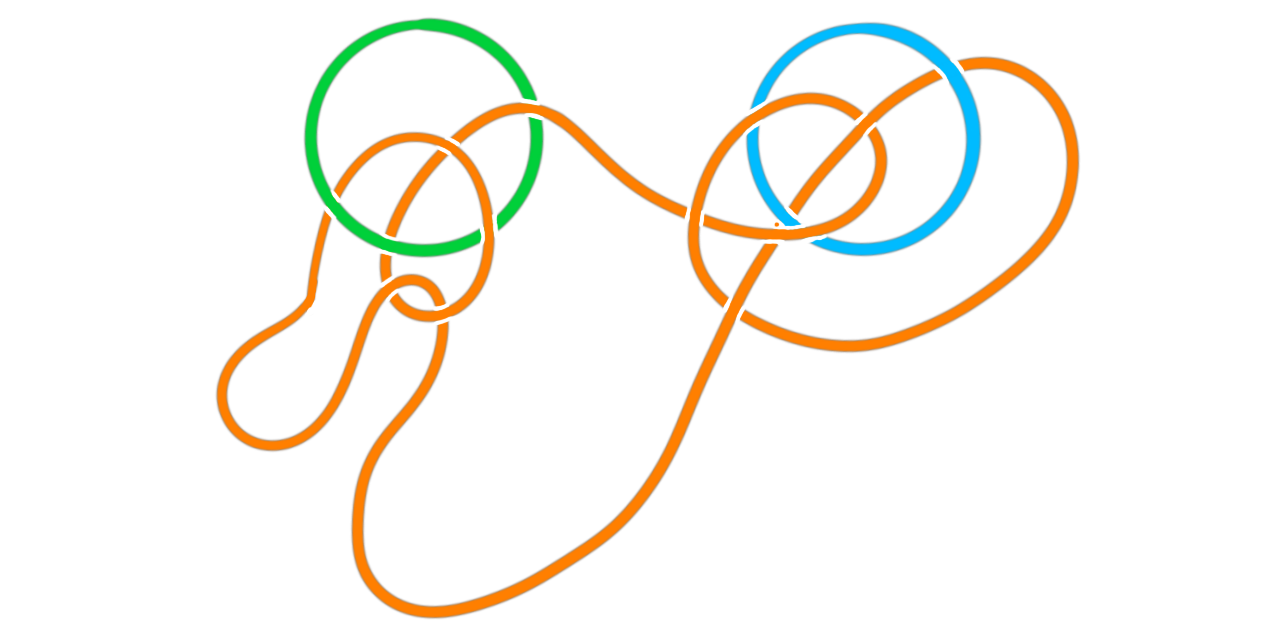
Last year I posted a blog post where we looked at a way to use elementary homotopy theory to hang a picture on the wall in a stupid way. The task was to hang a picture on two nails in such a way that if we pull one of the nails out, the picture falls down. “That is stupid” I hear you say, but premise is as premise does, or something similar quoted from Forrest Gump. I remarked then that I had seen the problem a couple years earlier, and I actually recently found were, which is how this blog post got made. I initially came across the problem from a video by a YouTube channel called GoldPlatedGoof. I watched the video again recently and decided to look around math-YouTube for other videos on the problem. There I came across one similar, and a bit less rigorous video by Matt Parker and Steve Mould. They solved it similarly to the original one, i.e. by using commutators, which is formalized by using the fundamental groups we did last time when posting about this. More interestingly I came across a video by Tom Scott and Jade Tan-Holmes which used a completely different (yet actually the same) method for solving it. Jade used knots and braid diagrams to produce a solution for the problem, which inspired me to make this post. We are also going to solve the problem using knots. The overall tactic will be roughly the same as Jades, but the method and the proof will be a bit different. The post has turned out to be quite long, but there are many pictures, and not that much text! ...

January 6, 2021