The homotopy groups of the spheres. Part 2

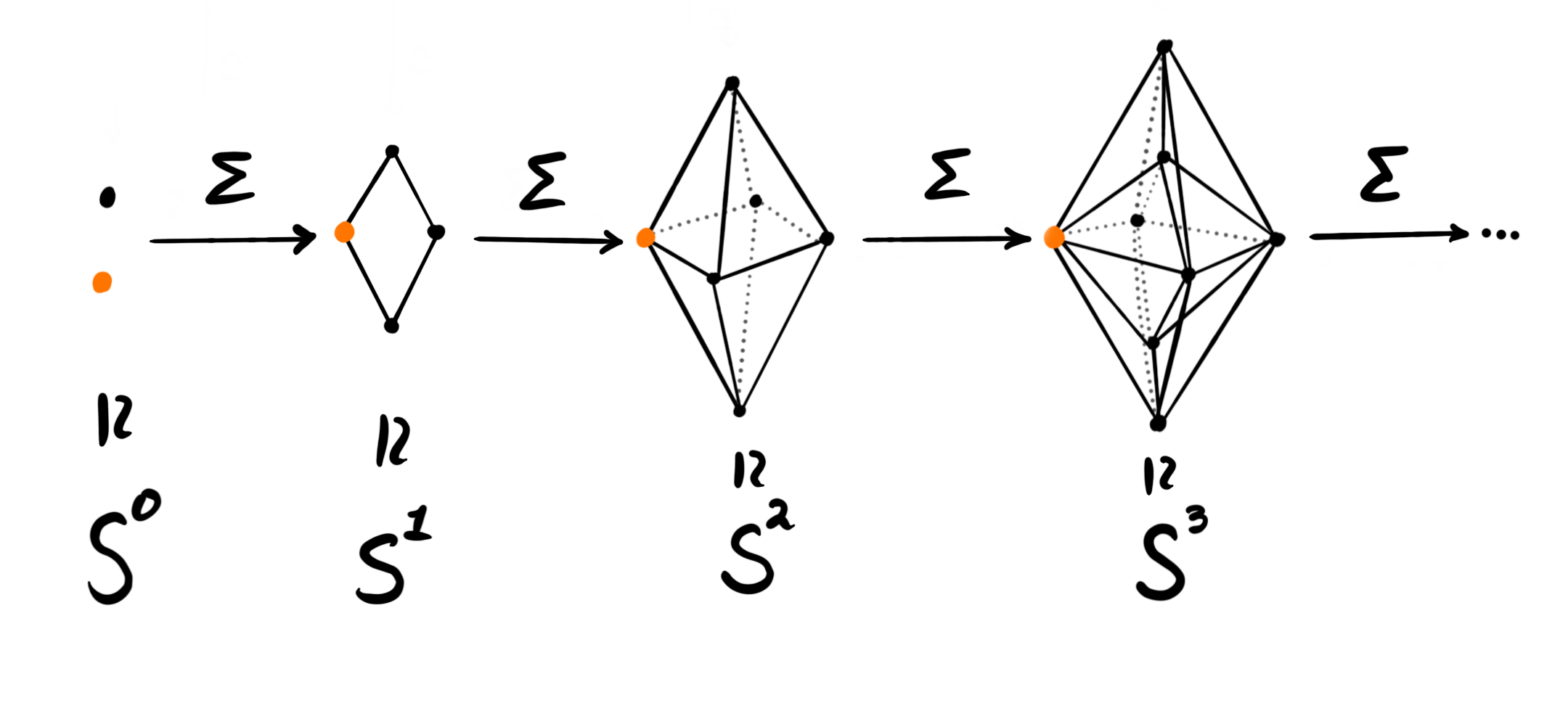
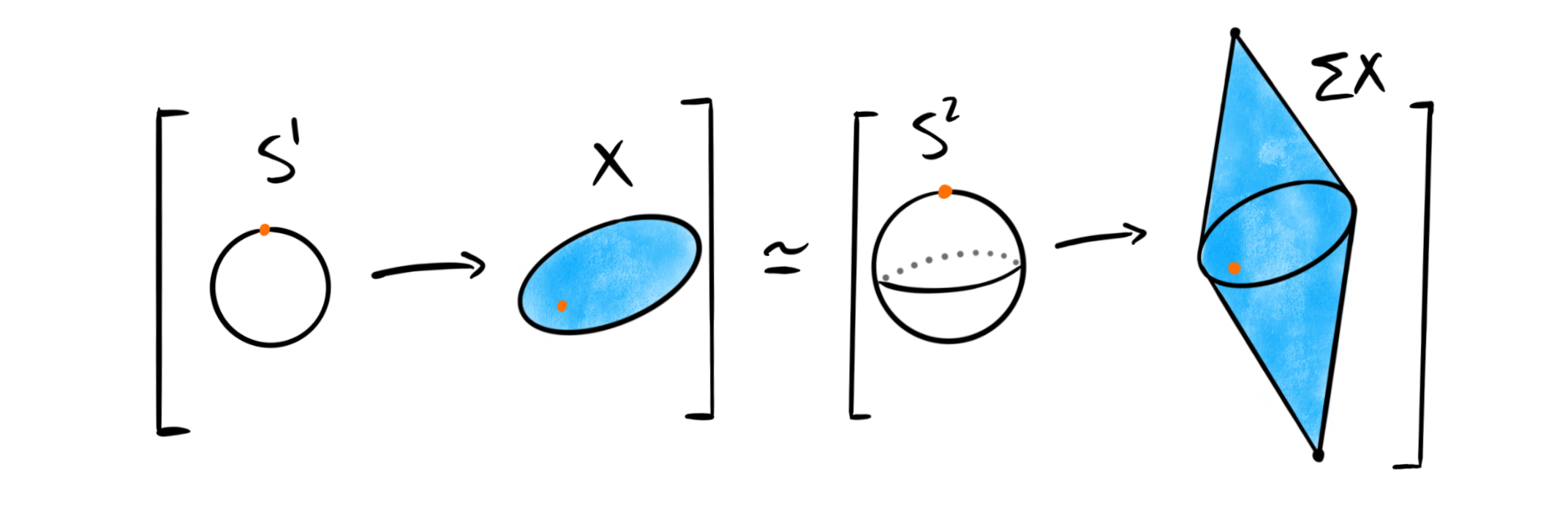
In the previous post we studied some “easy” cases of homotopy groups of spheres. We focused most on the group $\pi_3(S^2)$ and its computation from the Hopf fibration. All groups calculated last time were part of the so-called unstable range, meaning that they are not invariant under suspension. Due to the Freudenthal suspension theorem we know precicely the stable range for homotopy groups of spheres, and these are given by the stable homotopy groups. These groups are what we will look at today (and what we looked at during the second part of the talk these two blog-posts are based upon). We will compute some of the low stable homotopy groups of spheres using the socalled $J$-homomorphism. But, in order to do this calculation we must cover a plethora of interesting mathematics. ...
November 8, 2021

The stable homotopy category

A little while ago we discussed the definition of a tensor triangulated category, and in that post we mentioned an example that we didn’t explicitly define, namely the stable homotopy category. The goal for todays post is to fix this. There are many ways of defining it, and some are actually better than others. As the name suggests, the stable homotopy category is a homotopy category, which we have discussed before in the fibration series. But the question is, what is it the homotopy category of? As we remarked in the post on tensor triangulated categories, it is the homotopy category of the category of spectra, and it is here that the different approaches lie. What exactly is the category of spectra, and which spectra are we even talking about? Is it the sequential spectra? or maybe the orthogonal spectra? or perhaps the symmetric ones? maybe $S$-modules or excisive functors? All these names of course means nothing to us yet, as we haven’t properly looked at any of them. We did however meet the $\Omega$-spectrum in an earlier post, but which of the above types does it belong to? ...

October 1, 2021

Stable homotopy

For the last few posts we have covered some theory surrounding cohomology theories, and today we want to do something else, namely again look at some homotopy theory. It’s been a long time since we have covered homotopy groups, but today we return once again. In particular I want to cover a theorem and its consequences — the Freudenthal suspension theorem. This is one of the central theorems in the homotopy theory of topological spaces, and is one of the more important theorems we left out from the fibration series. In fact, we actually used it, or at least almost when we said: “Hence the suspension functor should shift the degrees of the homotopy groups up by one” in this post. Today we make this precise, and look at a cool thing that happens as a consequence of this. ...

September 24, 2021

Formal group laws

Recently we have covered a lot of heavy topology and abstract mathematics, so today I thought we would cover something else — something maybe a bit easier to grasp. We will introduce the concept of formal group laws, and a bit on why they are interesting. Introduction and definition To not just spew out the definition straight away, we look at a situation where formal group laws arise very naturally. Let $G$ be a one-dimensional commutative Lie group (Think here of the real numbers $\mathbb{R}$ or the circle group $S^1$). This group has a continuous product, $m:G\times G\longrightarrow G$, which locally can be described by a real-valued function in two variables. This function has a Taylor expansion around the origin, which is a power series in two variables. Denote this power series by $F$. This power series satisfies some axioms because of the group structure we have on $G$, these axioms are identity, commutativity and associativity. In more mathematical terms this means that the following statements hold ...

September 3, 2021

A first look at spectra

Even though this blog is not centered around a specific topic, we have during the last year looked more frequently at certain topics than others, such as (co)homology theory, homotopy theory and category theory. We will continue this trend today as we will try to find a solid reason for a particular object to exist. These objects were briefly mentioned in the earlier post on tensor triangulated categories, namely spectra. These objects are hugely important to the field of algebraic topology, one reason being that they are intimately linked to cohomology. This intimate connection is the study of todays blog post1. ...

August 20, 2021

Tensor triangulated categories

For the last five years mathematics has been my passion, as well as my main focus in life. This passion for mathematics will hopefully not diminish, as I am now heading into four more years of studies and research through a PhD in mathematics at NTNU. I am joining a project, called Tensor triangulated geometry in Trondheim, so today I thought I would explore the definition of one of the main players in this theory, namely tensor triangulated categories. We have already met half of this structure during our several encounters of monoidal categories, but the other half remains, as well as how to glue them together into a cohesive joint structure. ...

June 28, 2021