The homotopy groups of the spheres. Part 1

Recently I gave a talk about the homotopy groups of spheres, and as usual, I try to collect my thoughts on this blog before (or after) presenting. The homotopy groups of spheres have featured several times on this blog, and we have made some effort into calculating them for some small dimensions. In the talk I wanted to showcase some methods used to calculate these groups, as well as doing some of the “calculations”. We have met several of the tools before, like the long exact sequence from a fibration and the Freudenthal suspension theorem, but we will also meet some new ones, like the $J$-homomorphism and the $h$-cobordism group. These two are methods for calculating the stable homotopy groups of spheres, or at least some of their subgroups. For the low dimensional cases, these subgroups will luckily be the entire groups. Due to the length of the post I have split it into two: one covering the unstable homotopy groups, mostly focusing on the Hopf fibration, and one covering the stable groups, mostly focusing on the image of the $J$-homomorphism. Before we start we recall the definition of the homotopy groups of spheres. ...
October 26, 2021

Traveling

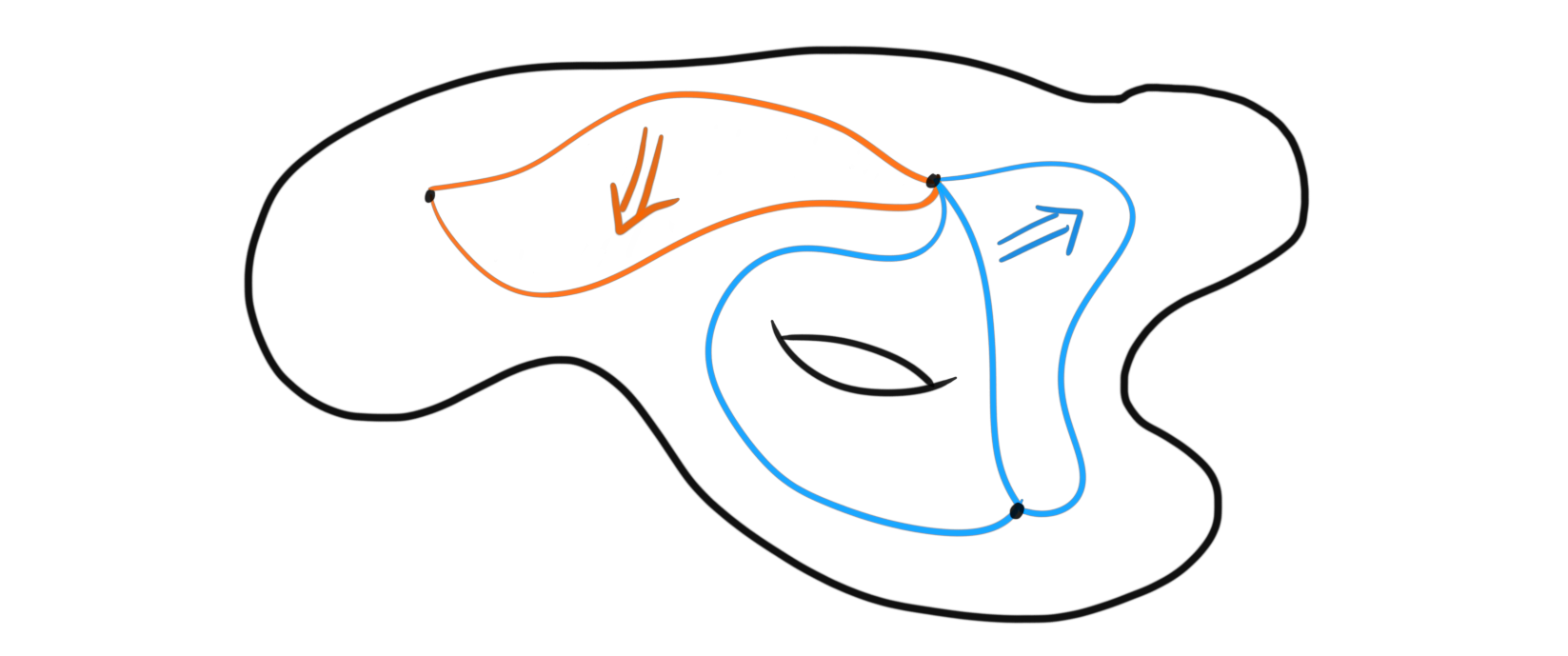
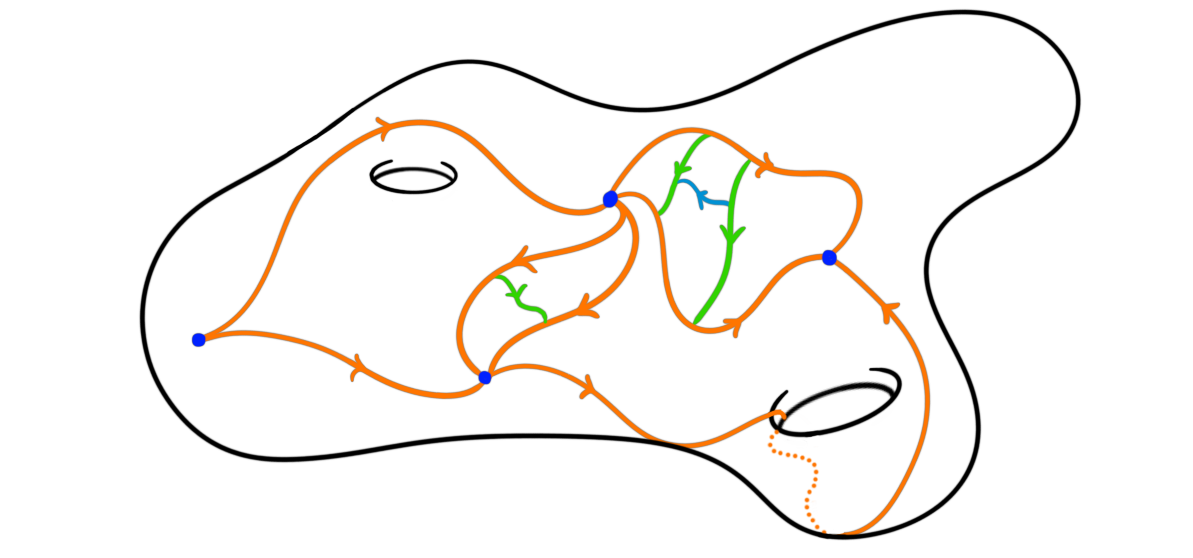
How can we use travel-journaling to study some highly abstract and highly complicated mathematical machinery? Can we get anything out of such an analogy? In this post we do just that, study the homotopy hypothesis and infinity groupoids through the lens of a travel ledger.

July 21, 2021

Sha-algebras

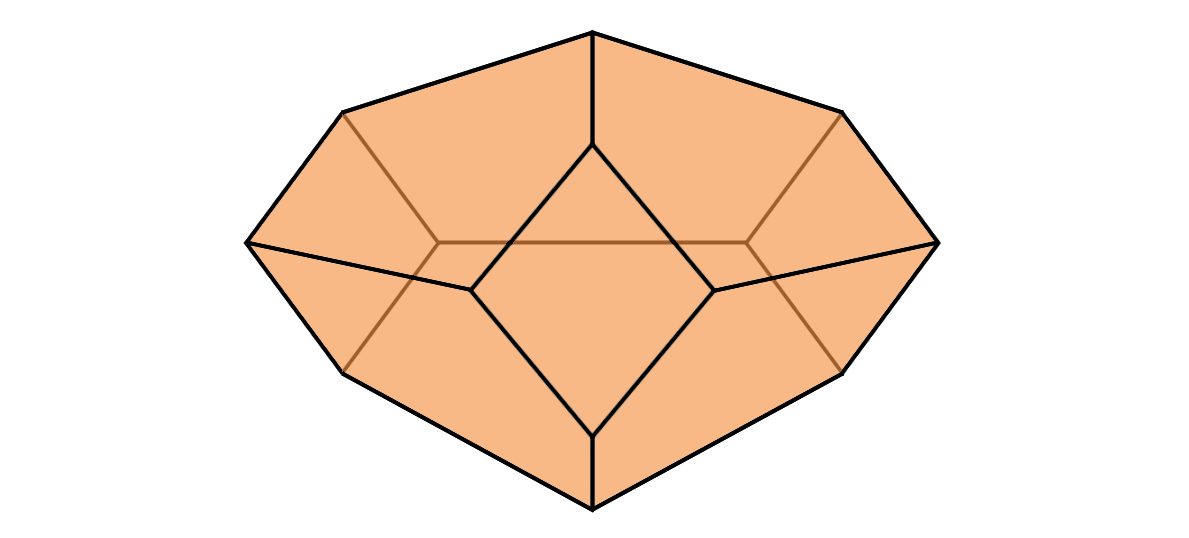
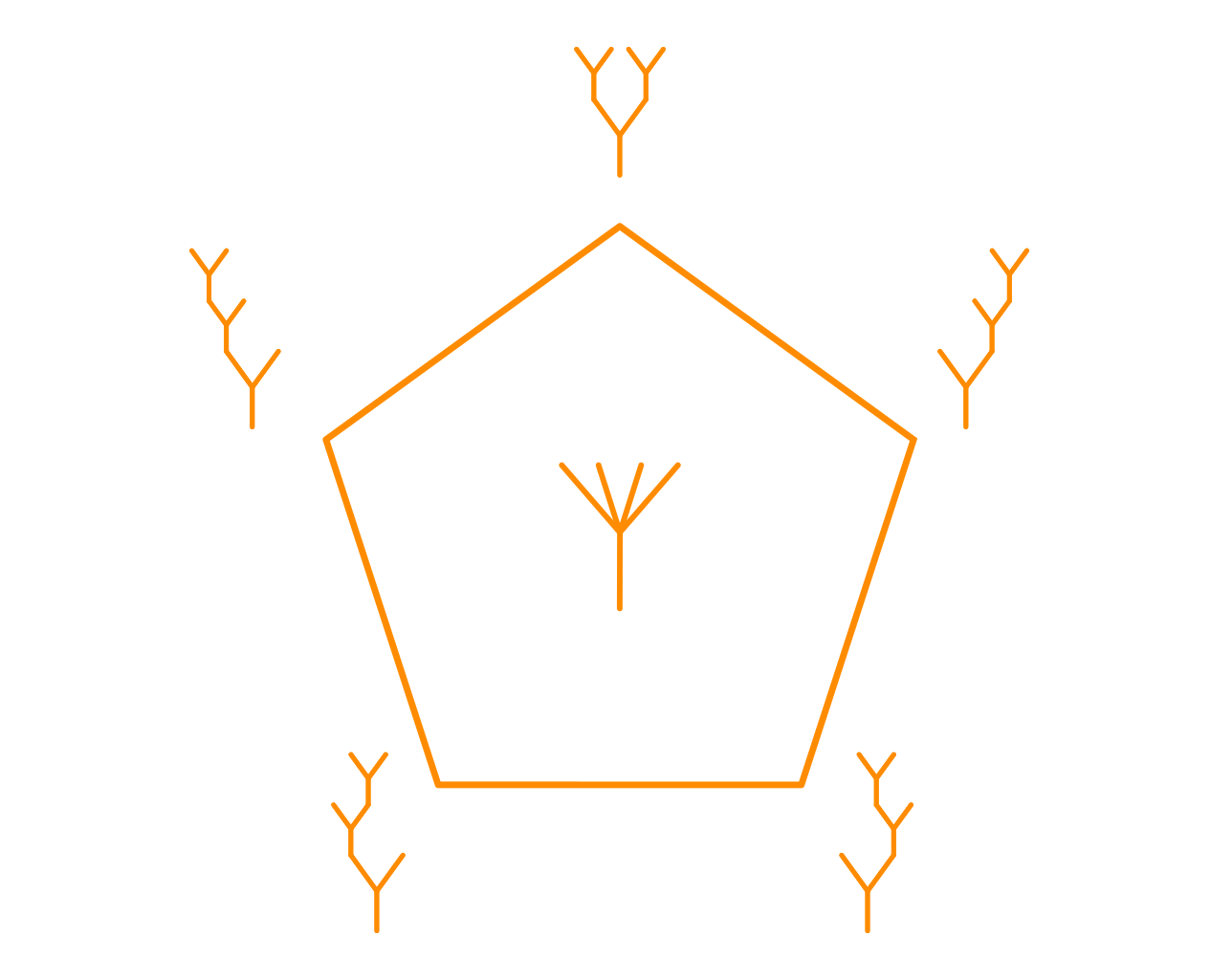
This is part four in a sort of connected story about operations in mathematics that are associative up to homotopy. It will probably be beneficial to read part 1, part 2 and part 3 in advance of this, but it is not required in theory. These previous posts do however build up some intuition and motivation for the object we are looking at today. To quickly recap what we already seen in these previous posts we recall that we started out by looking at how to transfer a group structure on a topological space through an isomorphism. We saw it produced the same structure, so we weakened to looking at transferring it through a homotopy equivalence instead. We then got an operation that was associative only up to homotopy, which we studied a bit through the so called Stasheff associahedra. We then introduced H-spaces and saw that some of these, in particular loop spaces, had the same type of homotopy associative operation. In the latest edition we looked at a more algebraic situation, still heavily motivated by the topology we had discussed earlier. In this situation we explicitly described a ternary operation that we proved was the associating homotopy and saw that we got a certain relation involving the associator and the boundary of the associating homotopy. ...

April 19, 2021

The associating homotopy

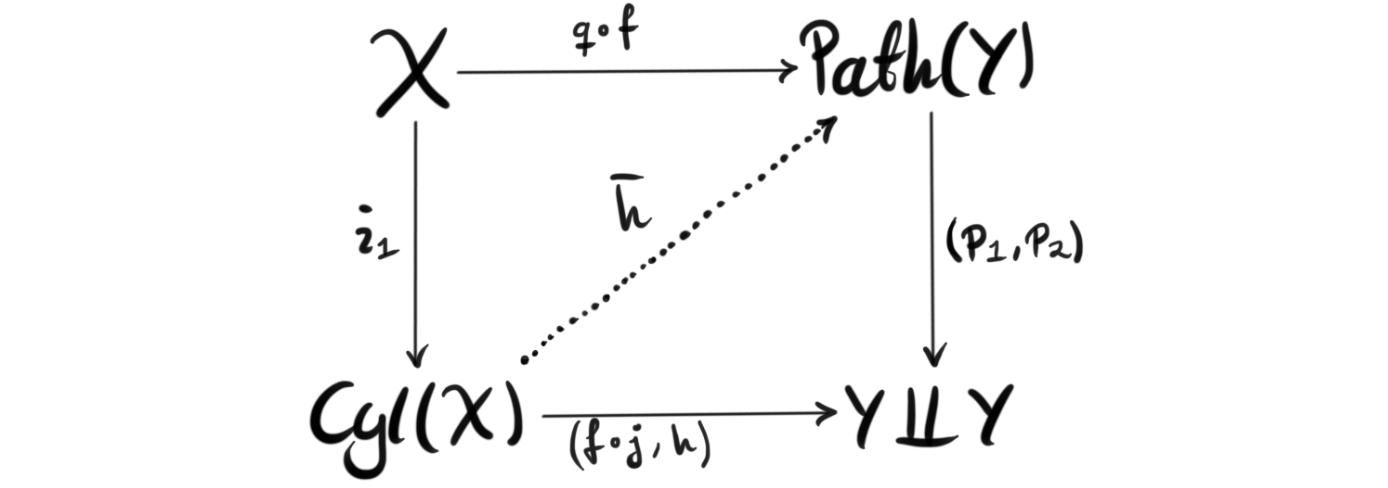
In the two last posts we have been discussing operations that are associative up to homotopy, and where such operations might arise naturally in topology. One claim I made, which I later realized was maybe a bit unmotivated and in need of some clarification was how some higher arity maps actually defined (or were defined by) homotopies between combinations of the lower arity maps. We also purely looked at this in a topological setting, but in algebraic topology we often translate to algebraic structures, so I also wanted to see clearly that the same constructions hold in that setting. To be more precise I am talking about the claim that a map we denoted by $m_3$ was a homotopy between $m_2(id\otimes m_2)$ and $m_2(m_2 \otimes id)$, where $m_2$ was a product induced through a homotopy equivalence. Don’t worry if you don’t recall the definitions and this problem, we will go through it again shortly. Today we in fact upgrade this earlier homotopy equivalence slightly such as to have a bit more to work with. As said we also take a turn away from standard topology and make our choice of “space” for this post to be chain complexes of vector spaces. I will not cover in detail why this is a reasonable thing to do but I will mention that the de Rham complex of a manifold, the rational singular cochains on a topological space and the rational cohomology of a topological space are all such structures. So, if we believe that algebraic topology is a nice way to study spaces, then studying these should be highly relevant. ...

April 3, 2021

Homotopy associativity

Imagine we have a system of two topological spaces $f:T\longrightarrow G$. We are often interested in knowing if a certain property on the space $G$ can be transferred through f such that we have the same property on $T$. If f is a nice enough morphism an example could be a topological invariant of $G$, for example its Euler characteristic. In this post we are more interested in transferring other things than invariants, more specifically structures. If $G$ has an algebraic structure, for example a group structure, can we then transfer the same or some other similar structure onto $T$ through $f$? ...

February 12, 2021

Quasi-categories

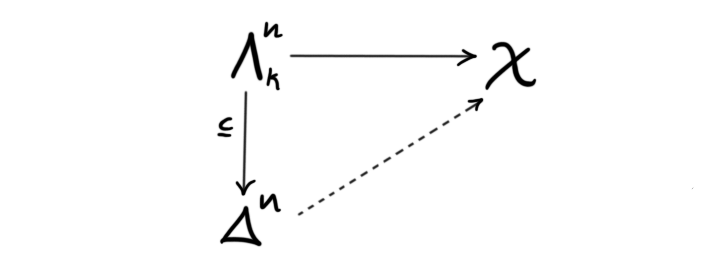
A couple weeks ago I held a talk on introductory higher category theory. Most of the talk was based upon thing we already have discussed on this blog, such as the strict $2$-category $Cat$, bicategories, and why strictness fails for the category of topological spaces. The inly thing I talked about which I haven’t yet featured on this blog is the notion of quasi-categories, so I though that I would do that today. So, to see where we are headed, I just define it right away. ...

November 30, 2020

The homotopy litmus test

A litmus test is a question asked in politics to a potential candidate for high office in which the answer determines if the person gets nominated or not. If a person or a committee holds the power of nominating candidates, they can use that power to make sure that a potential candidate holds their view on a certain matter. So, what does this have to do with mathematics, or especially with homotopy theory? There is a question worth asking certain objects to check if they should be allowed to be a suitable “definition” for a certain nice structure. The question, or test, which we will look more closely at soon, first started as a conjecture by Grothendieck, named later “the homotopy hypothesis”. This conjecture is still open in the way formulated by Grothendieck, but it can be turned on its head to form this test instead. The reason this is possible is because of ambiguity in a certain definition in higher category theory, and because there is seemingly many inequivalent “definitions” for the same object. Before exploring any theory at all, the conjecture states that $\infty$-groupoids are equivalent to topological spaces. The litmus test then becomes; $X$ is considered a definition of $\infty$-groupoids if and only if all $X$s’ are equivalent to topological spaces. ...

September 30, 2020

The homotopy category

This is part 9 of a series leading up to and exploring model categories. For the other parts see the series overview. Last time we ended by giving a definition of a homotopy between maps on the collection of bifibrant objects in a model category. Today we are going to expand further upon this idea, and try to build the theory we are familiar with for topological spaces but in the general setting. The goal is to have a well defined workable notion of a homotopy category, and understand what it consists of. ...

June 14, 2020

Homotopy in model categories

This is part 8 of a series leading up to and exploring model categories. For the other parts see the series overview. Last time we finally defined the model category, gave some examples and tried (kind of) to give a motivation to why they are interesting and how they set the stage for homotopy theory. The first time I read the definition I was a bit confused about the lack of mention of homotopy, or at least some prototype of it that I could connect with. This structure on a category is supposed to embody where homotopy theory works, but failed to immediately convey that to me. But, that said, we will today go through the construction of homotopy, and prove that it is an equivalence relation on maps in nice cases. These cases we mentioned in the previous part, and will be maps between objects that are both fibrant and cofibrant, which I will refer to as bifibrant. ...

June 7, 2020

Model categories

This is part 7 of a series leading up to and exploring model categories. For the other parts see the series overview. Finally we have made it to the destination we set, namely, more abstraction. This post is focused on the definition and intuition on model categories, which abstracts the objects we have been studying for some weeks, namely fibrations and cofibrations. The main definition is that of a model structure on a category, which together with a nice category will form the definition of a model category. So, why do we want this? There are more than one reason. ...

June 6, 2020